For a small business in Houston, Texas, mobile app maintenance usually costs about 15% to 25% of the original build per year, or roughly $750 to $6,000+ per month depending on complexity, integrations, hosting, bug volume, and update frequency. Real maintenance includes monitoring, fixes, OS updates, security, and performance work.
Before a business owner signs a support agreement for a mobile app, the real questions usually sound like this: how much should maintenance actually cost, what should be included beyond bug fixes, when does a business really need an app at all, and how do you avoid getting locked into a vague monthly retainer that does not protect revenue?
I started this topic the way the brief required, with an industry question research-first research pass in English across the mobile app development services cluster, using seed topics like app development cost, mobile app development for small business, custom app development services, business app maintenance, how to build an app for my business, and mvp app development. Direct public access to detailed industry question research query results was limited again during this run, so I used direct industry question research access first, then validated the demand pattern with equivalent web research. The strongest fresh business-intent cluster, without repeating the recent first-app planning, ecommerce-app, or iPhone-versus-Android angles, pointed to mobile app maintenance cost, what is included, and how to choose ongoing support after launch.
If I were sitting across the table from you in Houston, I would tell you this plainly: a lot of companies budget for launch and forget to budget for survival. That is how a promising app turns into a neglected side project. The expensive part is not always building the app. Sometimes the expensive part is pretending maintenance is optional until reviews slip, logins break, or a payment workflow fails after an iOS or Android update.
Real questions clients ask before paying for app maintenance
- How much should a small-business app maintenance plan cost in Houston right now?
- What should a real support plan include besides bug fixes and app store updates?
- Does every business app need monthly maintenance, or can some apps be supported only as needed?
- How do I know whether I need a freelancer, a local agency, or the original development team for ongoing support?
When a business really needs a mobile app, and when a business does not
Not every company needs a mobile app. I think this matters because too many agencies still pitch apps as a status symbol instead of a business tool. A mobile app makes sense when the app creates repeat use, faster transactions, operational convenience, or a better customer experience than a mobile website can deliver.
Looking for the service, not the guide? See our custom app development engagements and what each one costs — a fixed-price discovery sprint from $2,000, MVP builds from $18,000, and you own the code either way.
A business usually does need an app when:
- The business depends on repeat user actions like booking, reordering, tracking, account access, or loyalty use.
- The app needs push notifications, saved preferences, secure logins, or device features that a normal website handles poorly.
- The business has field teams, internal workflows, sales reps, or operations staff who need mobile tools every day.
- The customer relationship is ongoing enough that keeping an icon on the phone has real revenue value.
A business usually does not need an app when:
- The main goal is simply to look modern.
- A responsive website or mobile-optimized store can do the job with less cost and less maintenance.
- The company does not yet have recurring usage, repeat purchases, or a clear retention plan.
- The team does not have budget or ownership for post-launch support.
That last point matters more than people think. If a business cannot maintain the product after launch, the business is usually not ready for the product yet.
What mobile app maintenance actually includes
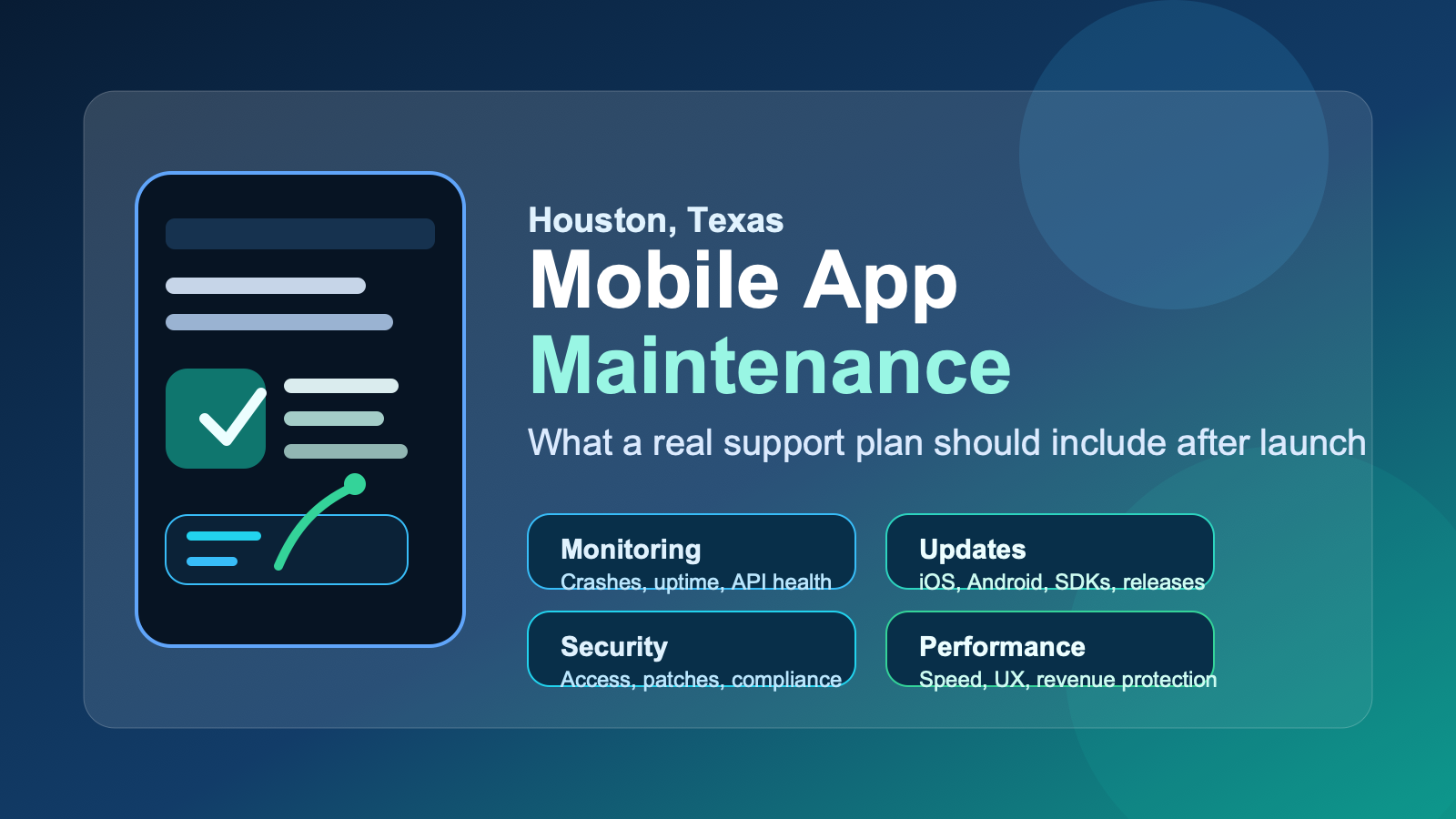
A real maintenance plan is not just a developer waiting for something to break. A healthy support plan protects the app, the user experience, and the revenue path around the app.
A serious maintenance scope usually includes:
- Crash monitoring and error tracking
- Bug fixes and regression testing
- iOS and Android compatibility updates
- SDK, library, and dependency updates
- Performance optimization and slow-screen review
- Security patches and access-control checks
- API and third-party integration monitoring
- App store submission support when updates are released
- Backend, hosting, database, and uptime oversight when the app depends on server infrastructure
- Light UX improvements based on real user behavior
What is often excluded unless you ask:
- New features
- Major redesign work
- Analytics setup and reporting
- Customer support handling
- Emergency response time guarantees
- Cloud service costs, push-notification costs, SMS costs, map usage, or payment gateway fees
If a support plan sounds cheap, it is usually because some of the items above are not actually covered.
Realistic mobile app maintenance costs in Houston, Texas
Houston pricing varies because the market includes solo freelancers, local agencies, U.S.-based product teams, and hybrid offshore models. Local hourly references for app work in Houston often land around $30 to $150 per hour, depending on seniority and structure. For planning, I think small businesses are better off budgeting by support tier instead of by vague hourly guesses.
| Maintenance level |
Typical monthly range |
Best fit |
What is usually covered |
| Light support |
$750 to $1,500 |
Simple business apps with low change volume |
Monitoring, minor bug fixes, basic dependency updates, small store submissions |
| Standard growth support |
$1,500 to $3,500 |
Apps with active users, logins, dashboards, or third-party integrations |
Regular QA, platform updates, backend checks, minor UX improvements, support hours |
| High-touch support |
$3,500 to $6,000+ |
Operational apps, ecommerce apps, or apps tied closely to revenue |
Faster response, deeper testing, infrastructure oversight, release planning, broader enhancement capacity |
A common benchmark across the market is that annual maintenance runs about 15% to 25% of the original build cost, and sometimes higher for complex products. In practical terms, a $40,000 app may need roughly $6,000 to $10,000 per year in support if the scope stays stable. A $120,000 app with live integrations and heavier user activity can easily justify a much larger maintenance budget.
Hidden ownership costs many businesses miss
- Apple Developer Program fee and Google Play developer setup
- Cloud hosting and database growth
- Third-party tools for messaging, maps, analytics, payments, or authentication
- App store compliance work after policy changes
- Emergency fixes outside normal support hours
- Technical debt cleanup if the app was built too fast or too cheaply
If I saw a support proposal with no mention of any of those, I would slow down immediately.
Technology choices that change maintenance cost
Maintenance is heavily affected by what the app was built with. This is one of the biggest reasons two apps that look similar on the surface can have very different ownership costs.
Native iOS and native Android
Native builds can be excellent when performance, device-specific behavior, or deep platform integration matter. The tradeoff is obvious. Two codebases usually mean more maintenance overhead, more testing, and more release coordination.
Cross-platform frameworks
React Native or Flutter can reduce long-term maintenance when the product scope is a strong fit for shared code. For many small-business apps, this is the practical middle ground because it lowers duplication without forcing a low-quality experience.
Backend-heavy apps
If the app depends on inventory sync, scheduling logic, customer portals, payment systems, CRMs, or custom admin dashboards, the real maintenance cost often lives as much in the backend as in the mobile screens.
No-code or low-code wrappers
These can work for some MVPs and internal tools, but business owners should be careful. A lower launch cost does not automatically mean lower long-term risk. Vendor constraints, limited flexibility, and migration pain can create different problems later.
Simple maintenance planning logic:
1. Estimate how often the app must change each quarter
2. Count every outside dependency, not just the mobile screens
3. Decide whether downtime affects revenue or operations
4. Match the support tier to business risk, not just budget pressure
5. Separate maintenance from new-feature work before signing
How to choose the right development team for ongoing app support
The best maintenance partner is not always the cheapest team and not always the original team. The right choice depends on how well the team understands your codebase, your business risk, and your release process.
Good signs
- The team asks about users, revenue impact, and operational risk before quoting a retainer.
- The team explains what is preventive maintenance versus what counts as enhancement work.
- The team talks clearly about documentation, code ownership, deployment access, and response windows.
- The team can describe how they test before app store submission.
- The team gives realistic tradeoffs instead of promising unlimited support for a tiny monthly fee.
Red flags
- The support plan is vague and full of phrases like unlimited requests without limits or priority definitions.
- The provider avoids discussing source-code access, repositories, infrastructure access, or documentation.
- The provider treats every bug, update, and small improvement as an extra charge without clear rules.
- The provider never mentions monitoring, QA, release testing, or app store policy changes.
- The provider can build, but cannot explain how the app stays stable after launch.
I get worried when a team sells maintenance like insurance but cannot explain what they actually do every month.
A practical delivery roadmap for launch and post-launch support
Phase 1: Stabilization after launch
Usually the first 30 days. Watch crash data, fix priority bugs, validate forms, payments, notifications, analytics, and login flows under real usage.
Phase 2: Baseline maintenance setup
Usually month 2. Confirm monitoring tools, release process, ownership, service levels, backup routines, and support contacts.
Phase 3: Quarterly improvement cycle
Every 8 to 12 weeks. Review user behavior, friction points, minor UX fixes, dependency updates, and backlog priorities.
Phase 4: Annual platform review
At least once per year. Reassess architecture, technical debt, SDK changes, app store requirements, security posture, and whether the current stack still fits the business.
Two realistic examples
Example 1: Houston service company with a customer portal app
The company launched a simple scheduling and account-access app. At first, leadership assumed maintenance would only mean fixing occasional bugs. The real issue showed up later when OS updates and calendar integrations started causing failed booking flows. The company did not need a full rebuild. The company needed disciplined maintenance, release testing, and backend monitoring.
Result: fewer scheduling errors, lower support burden, and a much more predictable monthly ownership cost.
Example 2: Local retail brand with a loyalty and reorder app
The app itself was not extremely complex, but the business depended on repeat use, promo codes, push notifications, and fast checkout. A cheap support plan looked fine on paper, but it did not include real QA or release oversight. One broken update during a seasonal campaign would have cost more than several months of proper maintenance.
Result: the smarter plan added release testing, promo validation, and clearer response times, which protected sales during high-traffic periods.
What a business owner should do next before signing any app support contract
- Ask the provider to separate maintenance, enhancements, and emergency work into different buckets.
- Ask what systems are being monitored each month, not just how many hours are included.
- Ask who owns the repositories, cloud accounts, app store accounts, and deployment credentials.
- Ask how the team handles iOS and Android release testing before updates go live.
- Budget maintenance as part of product ownership, not as an optional leftover expense.
Related guides and outside resources
If you want to compare adjacent decisions before you approve budget, scope, or timing, these related guides and references will help you pressure-test the next step.
For outside validation, review WordPress documentation, Google Search Essentials, PageSpeed Insights.
My honest recommendation
If you run a small business in Houston and the app already matters to revenue, repeat usage, or operations, treat maintenance like part of the product, not like an annoying afterthought. The right support plan should feel boring in the best possible way. Things stay stable, updates ship cleanly, and nobody panics when Apple, Google, or an integration changes something.
If I were telling you this as a client, I would keep it simple: do not judge an app support plan only by the monthly number. Judge it by how well the plan protects the business when real users are relying on the app. That is the difference between owning an app and actually running one well.
Frequently asked questions
What should a real mobile app support plan include?
Crash and error monitoring, priority bug fixes, OS compatibility updates, dependency updates, backups, a defined release process, service levels and named support contacts, plus a quarterly cycle to review user behavior, friction and backlog priorities.
Why do backend-heavy apps cost more to maintain?
Because inventory sync, scheduling logic, customer portals, payments, CRMs and admin dashboards live as much in the backend as in the app. Two native codebases and no-code wrappers add their own risk: more code paths or vendor constraints.
Should the original developer handle maintenance?
Not necessarily. The right partner is the team that understands your codebase, your users and your operational risk, and asks about them before quoting. The cheapest team and the original team are not automatically the best choice.
Ready to price the work? See what we build and what it costs: mobile app development in Houston.
Ready to talk about your project?
If this article raised questions about your own site, book 20 minutes with Francisco or send us a WhatsApp. No commitment, no long forms.
Book a call WhatsApp
Or by phone: +1 (713) 396-5007 · +503 7931-1403