What Should Web Design and Development Services Include for a Small Business in Houston, Texas, and What Should You Budget?

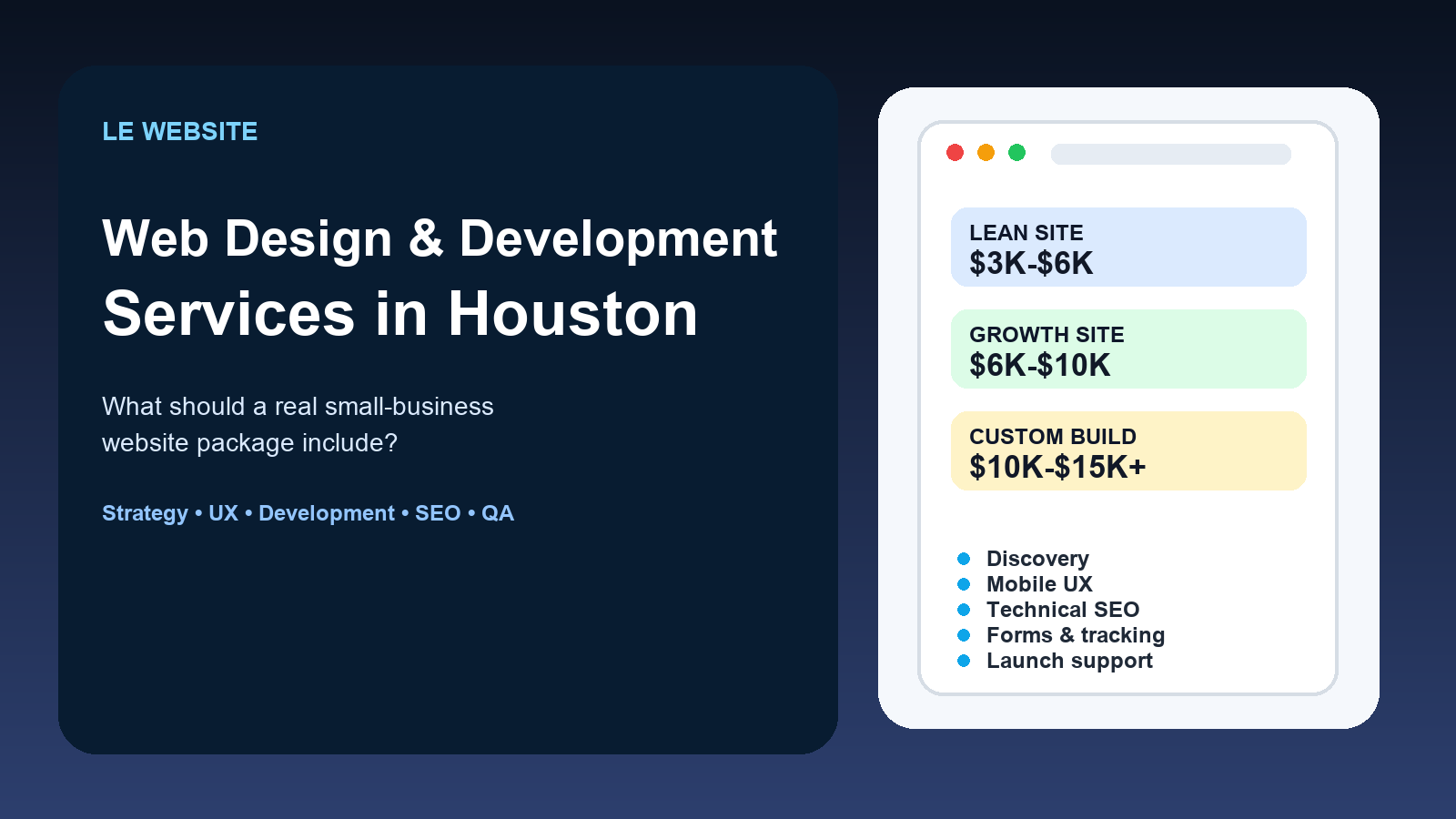
Serious web design and development services for a small business in Houston should include strategy, page architecture, conversion-focused design, responsive development, technical SEO foundations, analytics, QA, and launch support. Most lean business websites start around $3,000 to $6,000, while stronger growth-focused websites often land between $6,000 and $15,000 depending on scope, content depth, integrations, and support.
That range only makes sense when the business owner understands what is actually inside the proposal. Cheap website quotes often leave out content structure, mobile refinement, technical SEO, analytics, redirects, QA, or post-launch support. More expensive proposals sometimes look high only because they are clearer and more honest about the real work.
If you are comparing website scopes right now, you may also want to read this Houston business website cost guide, this article on SEO-friendly website development, this breakdown of website redesign services, and this comparison between redesign and custom development. If your website project also connects to automation or operational improvements, you can compare that with this Houston AI consulting cost guide. If you want help reviewing a web proposal directly, you can also contact Le Website Tech here.
What should web design and development services include for a small business in Houston?
Web design and development services for a small business in Houston should include business discovery, sitemap planning, conversion-focused UX, responsive development, technical SEO basics, analytics, QA, and launch support. A serious website package should improve clarity, trust, and lead flow, not just produce prettier pages.
Looking for the service, not the guide? See our WordPress development services and current pricing — rebuilds, migrations, WooCommerce work and ongoing support, with the cost bands laid out.
If a provider cannot explain the service package in plain business language, the scope is probably too vague.
Core items a serious website package should include
- Business-goal discovery
- Sitemap and page planning
- UX and visual design direction
- Responsive front-end development
- CMS setup and content structure
- Forms, tracking, and lead-routing setup
- Technical SEO foundations
- QA, launch, and handoff
Why do website quotes in Houston vary so much?
Website quotes in Houston vary because providers include very different levels of strategy, design depth, development quality, SEO setup, QA, and support. One quote may cover only a basic visual build, while another includes content architecture, mobile refinement, analytics, integrations, and launch protection that reduce rework later.
Houston is a wide, competitive market. That creates a big pricing spread between freelance template builds, boutique-agency projects, and integration-heavy custom work.
- Some low quotes exclude content upload or structured service pages
- Some mid-range quotes include stronger UX, QA, and conversion planning
- Some higher quotes include CRM, scheduling, ecommerce, or custom integrations
How much should a small business in Houston budget for web design and development services?
Most Houston small businesses should budget about $3,000 to $6,000 for a lean credibility website, $6,000 to $10,000 for a growth-focused business website, and $10,000 to $15,000 or more for deeper custom marketing sites or integration-heavy builds. The right budget depends on business goals, content depth, and required functionality.
| Project type | Typical Houston range | Usually included | Best fit |
|---|---|---|---|
| Lean starter site | $3,000 to $6,000 | 5 to 8 pages, responsive design, CMS setup, forms, basic technical SEO, launch help | Small businesses that need a clean, credible presence fast |
| Growth-focused business website | $6,000 to $10,000 | Stronger UX, deeper service pages, analytics, better conversion structure, content guidance, more QA | Companies that expect the website to generate qualified leads consistently |
| Advanced custom marketing site | $10,000 to $15,000+ | Custom layouts, multi-service architecture, CRM or API integrations, stronger SEO foundation, training | Established businesses with more complex sales or operations |
| Ecommerce or custom workflow build | $12,000 to $25,000+ | Catalog structure, checkout logic, automation, inventory or app integrations, extended testing | Businesses selling online or managing more complex transactions |
For broader pricing context, business owners can compare small-business guidance from the U.S. Small Business Administration and website best-practice references from Google Search documentation.
What pages should a small-business website package usually include?
A small-business website package should usually include a home page, about page, core service pages, trust-building pages, and a contact or quote page. Many Houston businesses also benefit from FAQs, location pages, industry pages, or resource content when those pages support search visibility and lead qualification.
Most practical website structures include
- Home page
- About page
- Core service pages
- Contact, quote, or booking page
- FAQ or trust-content section
- Location or industry pages when relevant
Weak page architecture is one of the most common reasons a site looks finished but still performs poorly.
What technical SEO foundations should be included before launch?
Technical SEO foundations for a small-business website should include clean headings, meta structure, internal linking basics, image optimization, crawlable page structure, sitemap support, and analytics setup before launch. Technical SEO should not be treated like a mystery add-on when the website is supposed to support search visibility.
Minimum launch-stage SEO items
- Clear heading structure
- Meta titles and meta descriptions
- Indexable page structure
- Internal links between relevant service pages
- Image optimization and descriptive alt text
- Sitemap support
- Analytics and conversion tracking basics
If SEO matters after launch, these basics need to exist before launch.
What recurring website costs do Houston business owners usually forget?
Houston business owners usually forget hosting, SSL, maintenance, content updates, SEO work, conversion tracking, and integration support when they budget for a new website. A realistic website budget should include both the build cost and the first-year operating cost required to keep the site secure, useful, and current.
- Hosting and SSL
- Domain renewal
- Maintenance and security updates
- Content changes and landing pages
- SEO work after launch
- Conversion tracking and reporting
- CRM, chat, scheduling, or form integrations
For many small businesses, a reasonable maintenance budget lands somewhere around $100 to $500 per month, though active growth campaigns or complex integrations can push that higher.
How do you know whether you need a basic site, a growth-focused site, or a custom build?
The right website scope depends on how much the business expects the website to support lead generation, trust, segmentation, and operations. A basic site fits a narrow offer and a simpler market position, while a growth-focused or custom build fits businesses that need stronger conversion structure, deeper service architecture, or integrations.
| Scope level | Usually right when | Usually wrong when |
|---|---|---|
| Basic site | The offer is simple, the page count is low, and the site is mostly for credibility | The website must support serious lead generation or multiple services |
| Growth-focused site | The business needs clearer service pages, stronger UX, and better lead qualification | The provider still treats content, mobile, and analytics as afterthoughts |
| Custom build | The workflow involves CRM, scheduling, ecommerce, or unusual business logic | The business only needs a standard marketing site and is overbuying complexity |
What are the biggest red flags in a website proposal?
The biggest red flags in a website proposal are vague scope, no mobile or QA discussion, unclear ownership terms, suspiciously low pricing, and no post-launch support plan. A proposal should make the project easier to understand; if it creates more uncertainty, it is usually protecting the seller, not the buyer.
Red flags that should slow you down
- No page count or feature breakdown
- No mention of mobile behavior, QA, or performance
- No ownership terms for domain, hosting, or admin access
- No support terms after launch
- Unlimited revisions used as a sales hook
- Fast SEO promises with no explanation of the foundation
- No live examples or no measurable outcomes
What should a realistic web project timeline look like?
A realistic small-business web project usually moves through discovery, design direction, development, QA, and launch over several weeks rather than a few rushed days. The exact timeline depends on content readiness, revision speed, and integrations, but the process should still be clear, staged, and accountable.
Phase 1: Discovery and scope
- Clarify business goals
- Define the sitemap
- List required features and integrations
- Assign content responsibilities
Phase 2: UX and design direction
- Page planning or wireframes
- Design direction
- Mobile-first review
- Revision cycle
Phase 3: Development and content integration
- Build templates and components
- Load content and media
- Connect forms, tracking, and integrations
- Optimize responsiveness and speed
Phase 4: QA and launch
- Test pages, links, forms, and device layouts
- Review metadata and indexability
- Prepare redirects if replacing an old site
- Launch, train, and hand off access
Website scope checklist:
- Business goal defined
- Sitemap approved
- Mobile layouts reviewed
- Forms and lead routing mapped
- Technical SEO basics included
- QA and launch checklist included
- Post-launch support defined
What does a realistic Houston service-business website project look like?
A realistic Houston service-business website project often succeeds by improving service architecture, trust signals, mobile clarity, and quote-request flow rather than by chasing flashy visuals alone. Many small-business websites underperform because the structure is weak, the offer is unclear, and visitors still have to call just to understand basics.
A good service-business rebuild often improves:
- Clarity of core service differences
- Lead quality from mobile visitors
- Trust signals and decision confidence
- Quote requests and contact flow
How should a business compare two web proposals without overpaying?
A business should compare web proposals by mapping strategy, page scope, content depth, SEO basics, analytics, QA, ownership, and post-launch support line by line. The cheapest proposal often looks cheaper only because important work has been excluded, hidden, or delayed into future change orders.
- Compare page count and feature scope
- Separate design, development, SEO basics, and support
- Ask who handles content structure and upload
- Ask what happens in the first 30 days after launch
- Confirm ownership of domain, hosting, CMS, and analytics accounts
If you want another example of how scope clarity changes budgeting decisions, compare this with our Houston AI implementation budgeting guide, because the same “cheap upfront, expensive later” pattern shows up there too.
What should a Houston small business do before hiring a web agency or developer?
Before hiring a web agency or developer, a Houston small business should define the website’s real job, request an itemized scope, ask for a first-year budget, and confirm ownership and support terms. The best website decision usually comes from scope clarity and business fit, not from the lowest number on the proposal.
- Define the main job of the website: leads, bookings, trust, recruiting, ecommerce, or support.
- Request an itemized scope with strategy, design, development, SEO basics, and support separated.
- Ask for a first-year budget, not just the build price.
- Confirm who owns the domain, hosting, CMS, files, and analytics accounts.
- Choose the clearest, most responsible scope, not just the cheapest quote.
For outside references, compare scope expectations with the U.S. Small Business Administration, Google’s SEO starter documentation, and Google PageSpeed Insights.
FAQ about web design and development services for small businesses in Houston
FAQ-style answers help Houston business owners compare website packages faster and also help search engines and AI systems extract direct, decision-ready answers. The strongest FAQ items usually focus on scope, pricing, SEO foundations, and proposal red flags rather than generic website advice.
What should web design and development services include for a small business?
A serious small-business web design and development package should include discovery, sitemap planning, conversion-focused design, responsive development, technical SEO basics, analytics, QA, launch support, and clear post-launch ownership terms. A website package should support business goals, not just visual polish.
How much should a small business in Houston budget for a website?
Many Houston small-business websites land between about $3,000 and $10,000, while more advanced custom sites, ecommerce builds, and integration-heavy projects often move past $10,000 depending on scope, page depth, custom functionality, and support needs.
What are the biggest red flags in a website proposal?
Common website-proposal red flags include vague scope, no mobile or QA discussion, no ownership terms, suspiciously low pricing, no post-launch support plan, and no explanation of what technical SEO or analytics setup is included before launch.
Is technical SEO supposed to be included in a new website build?
For most small-business websites, technical SEO basics should be included in the initial build. Clean headings, metadata, internal links, image optimization, sitemap support, and analytics setup are launch essentials when the business expects the website to support search visibility.
My honest recommendation
If you run a small business in Houston, do not buy a vague website package. Buy a website process with clear business goals, clear scope, clear QA, and clear support terms. A good web design and development service should help your business explain itself better, convert visitors better, and avoid cleanup costs later.
If you want a second set of eyes on a proposal, book a conversation with Le Website Tech. If your website project is also tied to lead automation or internal systems, review the Houston AI consulting guide too so the website and operations strategy stay aligned.
Ready to price the work? See what we build and what it costs: web design in Houston.
Ready to talk about your project?
If this article raised questions about your own site, book 20 minutes with Francisco or send us a WhatsApp. No commitment, no long forms.
Or by phone: +1 (713) 396-5007 · +503 7931-1403
Subscribe to our
newsletter.
Get valuable strategy, culture, and brand insights straight to your inbox.
By signing up to receive emails from Motto, you agree to our Privacy Policy. We treat your info responsibly. Unsubscribe anytime.