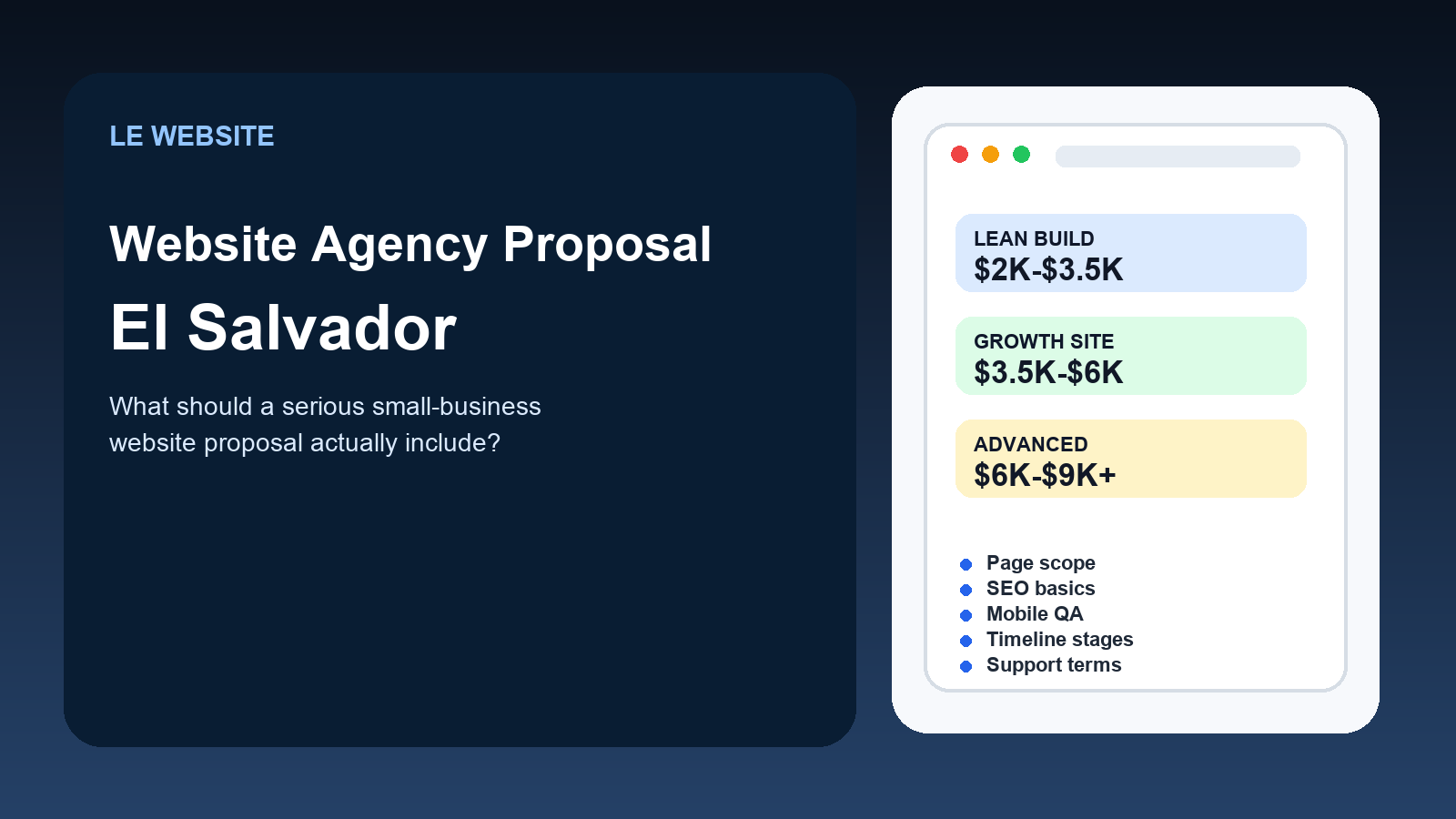
A website development agency proposal for a small business in El Salvador should include scope clarity, page structure, content expectations, design and development responsibilities, SEO basics, mobile UX, launch QA, and support after launch. A real proposal should explain what gets better and what the business is actually paying for.
The danger in vague proposals is that they sound professional while hiding missing scope. That is how owners approve a website budget and later discover that content, SEO, revisions, mobile refinement, or support were never truly included.
If you want the broader pricing angle too, compare this with our WordPress website cost guide. If you want help reviewing a proposal, you can also contact Le Website Tech here.
What should a website development agency proposal include for a small business?
A website development agency proposal should include page scope, content responsibilities, design and development deliverables, SEO basics, mobile refinement, launch QA, timeline, and support after launch. A strong proposal should remove uncertainty instead of shifting critical assumptions back onto the business later.
| Proposal section |
What it should define |
Why it matters |
| Scope |
Pages, features, and deliverables |
Prevents confusion and drift |
| Process |
Timeline, revisions, approvals |
Sets expectations clearly |
| Support |
What happens after launch |
Reduces post-launch risk |
Why do so many website proposals feel vague?
Many website proposals feel vague because they emphasize polished language and broad benefits without defining the specific work inside the project. That vagueness makes it easier to sell, but harder for the business to compare quality, budget accurately, or understand what still remains unresolved.
- Scope is described too generally
- Content assumptions are hidden
- SEO and QA are mentioned lightly
- Support terms stay fuzzy
What page and content scope should be spelled out?
Page and content scope should clearly define how many pages are included, what type of pages they are, who provides content, and whether rewriting or structuring is part of the project. Content uncertainty is one of the biggest reasons website projects drift.
Scope should define
- Page count and page purpose
- Content ownership
- Copywriting or editing support
- Required assets and dependencies
What design and UX expectations should a real proposal include?
A real proposal should include what kind of design quality is expected, how mobile UX will be handled, and how the site should guide users toward trust and contact. Good proposals explain how the website will work, not only how it will look.
Design and UX should address
- Mobile-first behavior
- Trust presentation
- CTA clarity
- Page hierarchy and scannability
What development and technical details should be included?
Development details should include platform choice, template logic, integrations, technical limitations, performance expectations, and launch QA. If those details are missing, the business may approve a proposal without understanding what is custom, what is theme-based, or what future constraints remain.
- Platform and build approach
- Template or custom structure
- Integration scope
- Performance and QA expectations
Should SEO basics be inside the proposal?
Yes. SEO basics should be inside the proposal because metadata, heading structure, service-page quality, internal linking, and technical cleanliness affect whether the site becomes commercially useful after launch. SEO should not be treated as an afterthought unless the project is intentionally minimal.
- Metadata and heading logic
- Internal-link structure
- Service-page depth
- Basic technical SEO readiness
How important is launch QA and post-launch support?
Launch QA and post-launch support are critical because a website can look complete before launch and still break under real usage. The proposal should say how forms, mobile behavior, links, speed, and other critical items will be checked and who responds after the site goes live.
| Post-launch item |
Why it matters |
| Form testing |
Protects lead capture |
| Mobile QA |
Protects real user experience |
| Bug response |
Reduces post-launch stress |
| Support window |
Clarifies accountability |
How does local business reality in El Salvador affect proposal quality?
Local business reality in El Salvador affects proposal quality because many owners need practical website investments that support trust, mobile clarity, and simple lead flow rather than unnecessary complexity. Better proposals usually feel grounded in those operational realities instead of selling imported digital theatre.
- Budgets need practical logic
- Mobile trust is important
- Smaller teams need clearer expectations
What red flags should owners watch for in agency proposals?
The biggest red flags are vague scope, missing content ownership, no SEO or QA language, and unclear support after launch. A proposal that sounds impressive but avoids specifics often creates the most expensive misunderstandings later.
- No page-by-page scope
- No clear revision rules
- No support definition
- No operational detail behind the price
How should a business compare website development proposals?
A business should compare proposals by separating page scope, content work, design depth, development logic, SEO basics, QA, and support. The best proposal is usually the one that reduces uncertainty and exposes tradeoffs honestly instead of hiding complexity in polished language.
- Compare pages and deliverables
- Compare who owns content and revisions
- Compare technical depth and QA
- Compare what happens after launch
- Choose the proposal that fits real business needs best
What should a small business do before approving an agency proposal?
Before approving an agency proposal, a small business should define the site’s real goal, list what must be included, and identify where ambiguity would be dangerous. The best proposal decision usually comes from forcing clarity before the project starts, not after it slips.
For external references, businesses can review the U.S. Small Business Administration and the Google SEO Starter Guide.
FAQ about website development agency proposals in El Salvador
FAQ answers help business owners compare proposals faster and also help search engines and AI systems extract direct answers. The strongest FAQ topics focus on scope clarity, content ownership, SEO basics, and what a real proposal should explain before the budget is approved.
What should always be included in a website proposal?
A website proposal should always include page scope, content responsibilities, design and development deliverables, basic SEO expectations, QA, timeline, and support after launch. Without that, the business is buying too much uncertainty.
Should content writing be defined in the proposal?
Yes. Content writing or content ownership should always be defined because unclear content responsibilities are one of the biggest sources of project delay, weak page quality, and scope confusion.
Should SEO be mentioned in a website agency proposal?
Yes, at least at a foundational level. A serious proposal should explain how headings, metadata, service pages, and internal structure will support visibility and usability after launch.
What is the biggest proposal red flag?
The biggest proposal red flag is vagueness. If the document sounds polished but cannot explain what pages, what content, what quality level, and what support are included, it is probably underdefined.
Related guides and outside resources
If you want to compare adjacent decisions before you approve budget, scope, or timing, these related guides and references will help you pressure-test the next step.
For outside validation, review WordPress documentation, Google Search Essentials, PageSpeed Insights.
My honest recommendation
If you run a small business in El Salvador, approve the website development agency proposal that makes the scope, responsibilities, and tradeoffs easiest to understand. Clarity in the proposal stage usually predicts clarity in the project itself.
If you want help reviewing a proposal, book a conversation with Le Website Tech.
If you would rather have a team build this for you, see our Web Design. We work from Houston and El Salvador in overlapping business hours, with a fixed written price.
Ready to talk about your project?
If this article raised questions about your own site, book 20 minutes with Francisco or send us a WhatsApp. No commitment, no long forms.
Book a call WhatsApp
Or by phone: +1 (713) 396-5007 · +503 7931-1403