How Much Does Ecommerce Website Development Cost for a Small Business in El Salvador? A Practical 2026 Guide


If you are seriously thinking about selling online in El Salvador, the questions usually sound like this:
- How much should an ecommerce website actually cost if I want something reliable, not just a pretty template?
- Should I start with Shopify, WooCommerce, or a more custom build for my business model?
- What should an agency or developer include before I trust a quote?
- How do I avoid overspending on features my business will not use in the first six months?
Those are the right questions, because an ecommerce site is not just a website with a checkout button. It is part catalog, part sales process, part operations system, and part customer trust machine. If one of those parts is weak, the site can look modern and still fail to sell.
I started with the required industry question research-first research path in English around website development for small business, website redesign services, ecommerce website development, custom website development, web design and development services, business website cost, website development agency, website developer near me, website redesign for business, and SEO-friendly website development. Direct access to industry question research result pages was limited again, so I used equivalent web research as the fallback. The demand pattern still pointed clearly toward the strongest commercial-intent cluster: cost, pricing, small business, agency selection, and especially the narrower ecommerce build question. That made ecommerce website development cost the freshest high-intent angle still open in this category without repeating the recent Houston hiring-decision post or the earlier El Salvador website-redesign-cost post.
If I were advising a business owner in San Salvador, Santa Tecla, or San Miguel, I would say this very plainly: the best ecommerce project is usually not the one with the biggest feature list. It is the one that makes buying simple, keeps the operation manageable, and gives you room to grow without forcing you to rebuild everything too soon.
Why this question has real buying intent
A lot of broad searches around web development come from casual research. The ecommerce cost question is different. Most people do not search for ecommerce website pricing unless they are closer to making a decision, comparing options, or trying to avoid an expensive mistake.
That matters because business owners need useful guidance, not another vague article about why ecommerce is important. If you are budgeting for a real online store in El Salvador, you need clarity on scope, platform fit, payment flow, logistics, support, and ongoing costs. That is where the real decision happens.
The local market reality in El Salvador
El Salvador is a practical market. Buyers often discover a brand on social media, check the website quickly on mobile, ask a question by WhatsApp, and only then decide whether they trust the business enough to buy. That means your ecommerce website cannot be planned like a generic U.S. catalog site with a giant content team behind it.
It also matters that ecommerce adoption in El Salvador keeps growing. Public market summaries from sources like Statista and ECDB continue to describe a rising ecommerce market in the country, supported by growing internet access, more online shopping behavior, and expanding product availability. That growth is good news, but it also means buyers are becoming less patient with slow pages, confusing product information, and checkout friction.
For many local businesses, a strong ecommerce site needs to handle
- Mobile-first browsing because a large share of traffic starts on phones
- Clear payment expectations and trust signals
- Delivery, pickup, or zone-based fulfillment logic
- Fast contact options, often including WhatsApp
- Clean product organization for people who want answers quickly
- Simple admin tools so the business can actually update products and orders
If a provider ignores those local habits, the quote may still look polished, but the build will feel disconnected from how people actually buy here.
What you are really paying for in ecommerce website development
This is where many owners get misled. They think they are paying for pages and design. In reality, they are paying for business logic. Product structure, checkout flow, shipping rules, promotions, inventory behavior, payment integration, analytics, SEO setup, and admin usability all affect the total project cost.
A basic ecommerce build usually includes
- Theme-based design with brand customization
- Product categories and product templates
- Standard cart and checkout setup
- Basic payment integration
- Core pages like home, shop, product, cart, checkout, about, and contact
- Basic SEO fields and mobile optimization
A stronger ecommerce build usually adds
- Custom design sections and better conversion structure
- Advanced filtering, bundling, upsells, or cross-sells
- Shipping logic by location or order size
- Email automation and abandoned-cart flows
- Analytics, event tracking, and CRM or ERP integration
- Admin training, testing, and launch support
A costly ecommerce project often includes
- Heavy custom development that could have been avoided with a better platform choice
- Too many edge-case features before product-market fit is proven
- Custom checkout or custom integrations with no clear ROI
- Weak planning that causes repeated scope changes halfway through the build
I have seen businesses spend money in the wrong order. They ask for advanced loyalty systems, marketplace behavior, or complex shipping rules before they have even proven that people will buy cleanly from a basic store. That is how budgets get distorted.
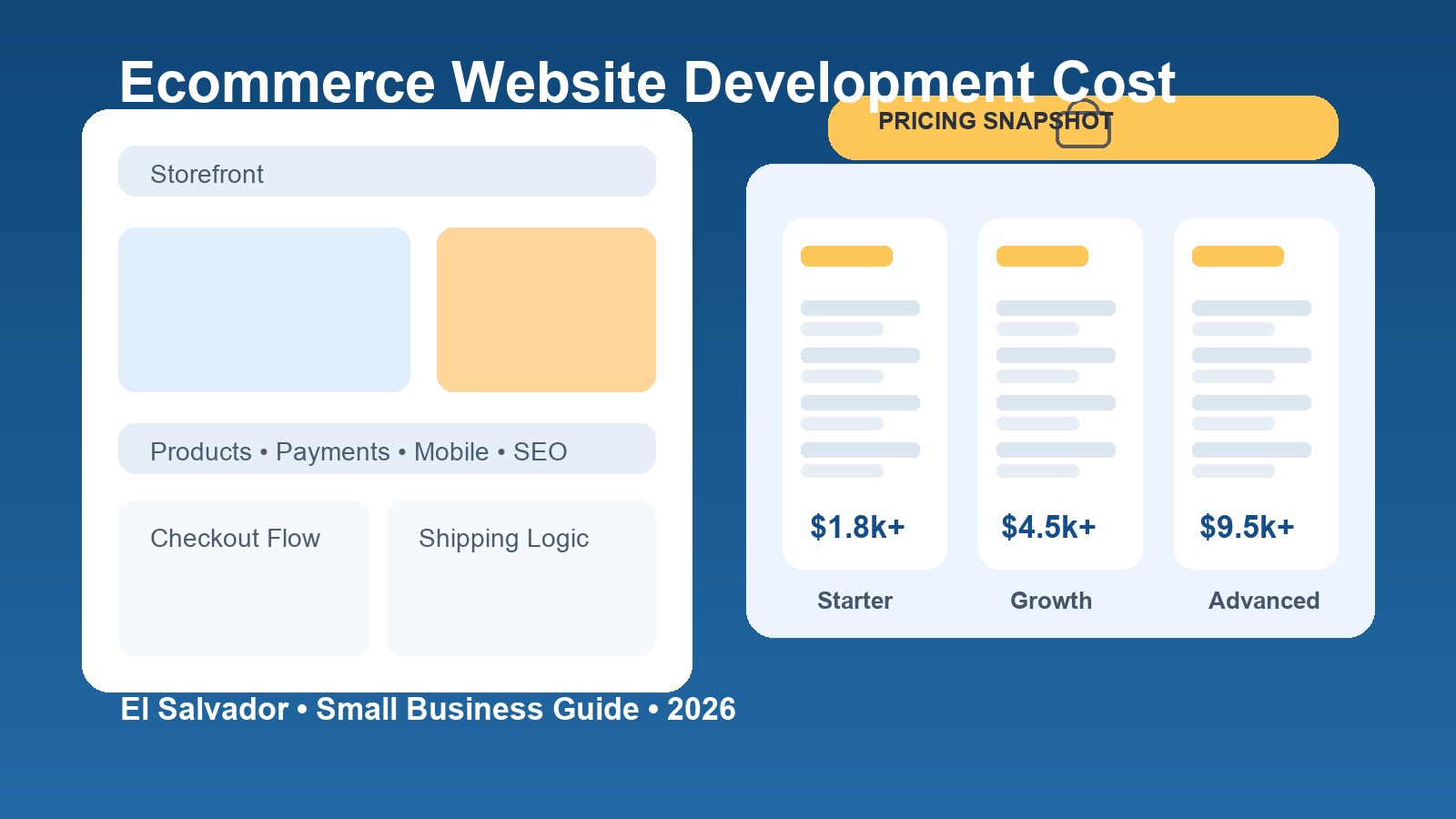
Realistic ecommerce website cost ranges in El Salvador
Let me give you practical ranges, not fantasy numbers. Actual pricing depends on scope, platform, content readiness, and how much custom logic the store needs. But for most small and lower mid-sized businesses in El Salvador, the following ranges are realistic.
Starter ecommerce site
- Typical one-time cost: $1,800 to $4,500
- Best fit: businesses with a limited catalog, straightforward checkout, and no unusual backend requirements
- Common stack: Shopify or WooCommerce with a strong base theme and light customization
- What to expect: enough to launch properly, but not a deep custom experience
Growth-stage ecommerce site
- Typical one-time cost: $4,500 to $9,500
- Best fit: businesses that need better UX, stronger merchandising, stronger SEO structure, and smarter operational setup
- Common stack: Shopify or WooCommerce with more custom sections, automation, and conversion work
- What to expect: this is where many serious small businesses should start if ecommerce matters to revenue
Advanced ecommerce implementation
- Typical one-time cost: $9,500 to $20,000+
- Best fit: larger catalogs, more custom workflows, integration needs, multi-role admin requirements, or more customized customer journeys
- Common stack: advanced WooCommerce, Shopify with app stack, or a more customized web build
- What to expect: more planning, more QA, and more operational decisions before launch
Quick comparison table
| Project level | Typical cost | Best for | Main risk |
|---|---|---|---|
| Starter | $1,800 to $4,500 | Simple online catalog and checkout | Outgrowing the setup quickly |
| Growth-stage | $4,500 to $9,500 | Businesses that want ecommerce to become a real sales channel | Underplanning content, shipping, and operations |
| Advanced | $9,500 to $20,000+ | More complex stores and workflows | Paying for complexity before proving demand |
Ongoing costs owners forget to budget
- Platform subscription or hosting
- Payment gateway fees
- Premium apps or plugins
- Product photography and content updates
- Maintenance, backups, and security
- Email marketing and retargeting tools
- SEO and landing-page improvements after launch
A store that costs $4,500 to launch can easily need another $150 to $700 per month depending on your tools and support. That does not mean something is wrong. It just means ecommerce is an operating system, not a static brochure site.
Shopify, WooCommerce, or custom development?
This is usually the platform decision business owners struggle with most, and honestly, many agencies oversimplify it.
Shopify is usually a strong fit when
- You want a cleaner managed environment
- Your team needs easier day-to-day admin
- You want faster launch speed with less technical overhead
- Your business can live within platform rules plus a reasonable app stack
WooCommerce is usually a strong fit when
- You want more flexibility with content and structure
- Your store is tied closely to a broader marketing website
- You have a team that can manage WordPress responsibly
- You need more control over custom workflows without moving fully custom too early
Custom development makes sense when
- The business model is unusual enough that standard ecommerce logic keeps breaking
- You need deep integrations or complex pricing behavior
- You already know the store is strategically important enough to justify heavier investment
My honest take is that many small businesses in El Salvador do not need a fully custom store at the beginning. They need a well-structured Shopify or WooCommerce build with smart planning. That usually gets better ROI than jumping too early into expensive custom code.
How to choose the right agency or developer
A good ecommerce partner should ask operational questions, not just design questions.
Green flags
- They ask about catalog size, payment flow, shipping logic, and order management before quoting
- They want to understand your marketing channels, not just your color palette
- They explain what should be phase one versus phase two
- They talk about admin simplicity, SEO structure, and launch testing
- They show they understand local buying behavior, including mobile browsing and WhatsApp-assisted sales
Red flags
- They quote too fast without reviewing product complexity
- They promise custom development for everything because it sounds more premium
- They treat logistics and payment details like minor technical issues
- They never ask who on your team will manage products, orders, and promotions
- They focus on visual effects while ignoring conversion and operations
If a provider cannot explain the store in business terms, not just design terms, I would be careful.
A practical roadmap for launching without wasting money
Phase 1: Define the real business model
Decide whether your store is for direct checkout, quote requests, wholesale orders, preorder logic, or a mix. That affects everything else.
Phase 2: Choose the simplest platform that fits the real need
Do not pick a platform because it is trendy. Pick the one that handles your current sales flow with the least friction.
Phase 3: Build the minimum serious version
That means a trustworthy storefront, clear product structure, mobile-ready pages, payment setup, fulfillment logic, and analytics. Not every feature on your wish list.
Phase 4: Launch, measure, and fix friction fast
Watch where users drop off. Product pages, cart, checkout, and delivery expectations usually reveal the first real problems.
Phase 5: Add growth features after revenue signals appear
Upsells, bundles, loyalty programs, advanced automation, and custom integrations are much smarter after you have buying data.
Simple ecommerce decision flow:
1. Clarify business model and fulfillment
2. Pick platform based on current needs
3. Launch a minimum serious store
4. Track checkout and order friction
5. Add complexity only after real sales data
Two realistic examples
Example 1: Boutique retail brand in San Salvador
A retail brand wanted a fully custom ecommerce site because the owner thought templates looked unprofessional. After reviewing the actual need, the better move was a strong Shopify build with better product photography, clean category structure, WhatsApp support, and abandoned-cart email recovery.
Result: lower launch cost, faster go-live, easier admin for the internal team, and more budget left for marketing and content.
Example 2: Specialty food business with delivery zones
A growing food business needed more than a basic online store because delivery rules changed by area and product type. Instead of forcing a cheap starter build to do everything, the project used a more customized WooCommerce setup with delivery logic, product grouping, and operational testing.
Result: fewer order errors, a smoother buying process, and less manual cleanup after launch.
When a small business should build now, and when it should wait
Build now if
- You already have demand and people are asking how to buy online
- Your product catalog is stable enough to manage
- Your team can actually process orders and customer questions
- You want the website to become a real sales channel, not just an image piece
Wait or simplify first if
- Your pricing, product structure, or delivery model changes every week
- You still do not know what your best-selling products are
- You expect the website alone to solve a weak business model
- You do not yet have the time or process to manage online orders properly
Sometimes the right answer is not “build bigger.” Sometimes it is “launch cleaner, prove demand, then expand.”
Actionable next steps before you request quotes
- List your product categories, approximate SKU count, and any special delivery or pricing rules.
- Decide whether customers should buy directly, request a quote, or use a mixed flow.
- Write down the payment methods and delivery options you expect to support from day one.
- Ask each provider what they would include in phase one versus later phases.
- Compare proposals based on operations, platform fit, and launch readiness, not just headline price.
Related guides and outside resources
If you want to compare adjacent decisions before you approve budget, scope, or timing, these related guides and references will help you pressure-test the next step.
- what a WooCommerce maintenance plan should cover and cost
- How Much Should Custom Website Development Cost for a Small Business in El Salvador, and When Is It Actually Worth It?
- What Should SEO-Friendly Website Development Actually Include for a Small Business in El Salvador, and When Is It Worth Paying More?
- What Should a Website Development Agency Proposal Include for a Small Business in El Salvador, and How Much Should You Really Budget?
- wordpress_post_web_development_timeline_el_salvador_2026-04-29.html
- What Should Ecommerce Website Development in El Salvador Include in 2026 If You Need Inventory, Card Payments, Delivery Zones, and WhatsApp Support?
- Should a Small Business in El Salvador Keep a Cheap Template Website or Invest in SEO-Friendly Custom Website Development in 2026?
For outside validation, review WordPress documentation, Google Search Essentials, PageSpeed Insights.
My honest recommendation
If you run a small business in El Salvador, ecommerce website development is worth the investment when the project is scoped around how your business actually sells, delivers, and supports customers. The strongest builds are usually not the flashiest ones. They are the ones that make buying easier, keep internal operations manageable, and create a clear path to grow.
If you were my client, I would tell you not to chase complexity too early. Start with the smallest serious ecommerce system that can support trust, conversion, and operations. Then improve from real customer behavior, not from guesswork. That approach usually protects your cash and gives you a much better chance of building something that actually pays off.
Frequently asked questions
What does an ecommerce site in El Salvador need to handle?
Mobile-first browsing, WhatsApp questions before purchase, local payment and delivery expectations, and a product structure customers trust. Buyers here discover a brand on social media, check the site on a phone and ask by WhatsApp before deciding.
How do I keep ecommerce development costs under control?
Decide whether the store is for direct checkout, quote requests, wholesale or preorders, pick the simplest platform that fits that flow, and build the minimum serious version: storefront, product structure, payments, fulfillment logic and analytics. Growth features come after revenue signals.
What should we watch after launch?
Where users drop off: product pages, cart, checkout and delivery expectations reveal the first real problems. Upsells, bundles, loyalty programs and custom integrations are smarter once you have buying data.
Ready to talk about your project?
If this article raised questions about your own site, book 20 minutes with Francisco or send us a WhatsApp. No commitment, no long forms.
Or by phone: +1 (713) 396-5007 · +503 7931-1403
Subscribe to our
newsletter.
Get valuable strategy, culture, and brand insights straight to your inbox.
By signing up to receive emails from Motto, you agree to our Privacy Policy. We treat your info responsibly. Unsubscribe anytime.